Cat-Safe Plants: 25 Non-Toxic Houseplants (and What to Avoid)
25 cat-safe houseplants that are non-toxic to cats, for low light, bathrooms, shelves and beginners, plus the popular plants to keep out of a cat home.
On this page
- The 25 best cat-safe houseplants at a glance
- Cat-safe plants for low light
- Cat-safe plants for the bathroom
- Cat-safe hanging and trailing plants
- Cat-safe succulents
- Cat-safe flowers and flowering plants
- Cat-safe herbs and plants cats can chew
- Popular plants that are NOT safe for cats
- Swap this for that: cat-safe alternatives to popular plants
- How to check any plant before you buy it
- How to stop your cat eating your plants (even safe ones)
- What to do if your cat eats a plant
- Frequently asked questions
You don't have to choose between a cat and a home full of plants. Plenty of popular houseplants are non-toxic to cats: spider plants, Boston ferns, calatheas, parlor palms, peperomias, orchids and more. The trick is knowing which ones are safe before you buy, because several of the most fashionable plants (monstera, pothos, snake plant, lilies) are not.
This list is based on the ASPCA's toxic and non-toxic plant database and covers plants for low light, bathrooms, shelves, flowers and herbs. You'll also find "swap" ideas for the plants cat owners most often ask about.
The 25 best cat-safe houseplants at a glance
| # | Plant | Botanical name | Light | Care level |
|---|---|---|---|---|
| 1 | Spider plant | Chlorophytum comosum | Bright, indirect | Very easy |
| 2 | Boston fern | Nephrolepis exaltata | Medium to bright, indirect | Moderate (likes humidity) |
| 3 | Parlor palm | Chamaedorea elegans | Low to medium | Easy |
| 4 | Areca palm | Dypsis lutescens | Bright, indirect | Moderate |
| 5 | Ponytail palm | Beaucarnea recurvata | Bright | Very easy |
| 6 | Cast iron plant | Aspidistra elatior | Low | Very easy |
| 7 | Calathea (peacock, rattlesnake) | Calathea / Goeppertia spp. | Medium, indirect | Moderate |
| 8 | Prayer plant | Maranta leuconeura | Medium, indirect | Moderate |
| 9 | Peperomia (baby rubber plant, watermelon) | Peperomia spp. | Medium | Easy |
| 10 | Money tree | Pachira aquatica | Bright, indirect | Easy |
| 11 | Bird's nest fern | Asplenium nidus | Low to medium | Easy |
| 12 | Staghorn fern | Platycerium spp. | Bright, indirect | Moderate |
| 13 | Polka dot plant | Hypoestes phyllostachya | Bright, indirect | Moderate |
| 14 | Friendship plant | Pilea involucrata | Medium | Easy |
| 15 | Hoya (wax plant) | Hoya carnosa | Bright, indirect | Easy |
| 16 | Haworthia (zebra plant) | Haworthiopsis / Haworthia spp. | Bright | Very easy |
| 17 | Echeveria | Echeveria spp. | Full sun | Easy |
| 18 | Burro's tail | Sedum morganianum | Bright | Easy |
| 19 | Christmas cactus | Schlumbergera spp. | Bright, indirect | Easy |
| 20 | Moth orchid | Phalaenopsis spp. | Bright, indirect | Moderate |
| 21 | Bromeliad | Guzmania and other bromeliads | Medium to bright | Easy |
| 22 | African violet | Saintpaulia spp. | Medium to bright | Moderate |
| 23 | Cat grass | Oat, wheat or barley grass | Bright | Very easy |
| 24 | Catnip | Nepeta cataria | Sunny windowsill | Easy |
| 25 | Basil | Ocimum basilicum | Sunny windowsill | Easy |
Cat-safe plants for low light
Dim rooms, north-facing windows and hallways suit these tough, shade-tolerant plants:
- Cast iron plant lives up to its name. It tolerates low light, irregular watering and drafts, and its stiff leaves are rarely interesting to cats.
- Parlor palm is a classic low-light palm that stays compact indoors. It is one of the best non-toxic swaps for a tall "statement" plant.
- Bird's nest fern has glossy, wavy fronds that cope with lower light better than most ferns.
- Calathea and prayer plant prefer medium light but forgive a shady corner. Their patterned leaves fold up at night, which some cats find fascinating.
- Peperomia tolerates average indoor light and stays small. It works well on desks and shelves.
Cat-safe plants for the bathroom
Steamy bathrooms with a window are ideal for humidity lovers:
- Boston fern: lush, fast-growing and happiest in humidity.
- Bird's nest fern and staghorn fern: staghorn ferns can be mounted on a board on the wall, out of paw reach.
- Moth orchid: thrives in bathroom humidity and bright, indirect light.
- Bromeliads: colourful, long-lasting and happy on a bright windowsill.
- Calathea: humidity prevents its typical crispy leaf edges.
Cat-safe hanging and trailing plants
Hanging baskets keep leaves away from chewers, but only hang safe plants. Leaves fall, cats jump, and baskets get knocked down.
- Spider plant is the classic hanging plant, but expect your cat to try to reach it. Many cats find the leaves irresistible (see below).
- Hoya trails beautifully and is a non-toxic alternative to pothos.
- Burro's tail is a trailing succulent with plump leaves that drop off easily, so hang it where you won't brush past it.
- Boston fern looks lovely in a hanging basket.
Cat-safe succulents
Many succulents are toxic to cats, including aloe vera, jade plant, kalanchoe and euphorbias. These are the safe ones:
- Haworthia (zebra plant): looks like a small aloe, is safe and is hard to kill.
- Echeveria: rosette succulents that need a sunny windowsill.
- Burro's tail: trailing, and safe.
- Ponytail palm: technically a succulent, with a swollen trunk that stores water.
- Christmas cactus: no sharp spines and non-toxic, with winter flowers.
Cat-safe flowers and flowering plants
For flowering houseplants, choose moth orchids, African violets, bromeliads and Christmas cactus.
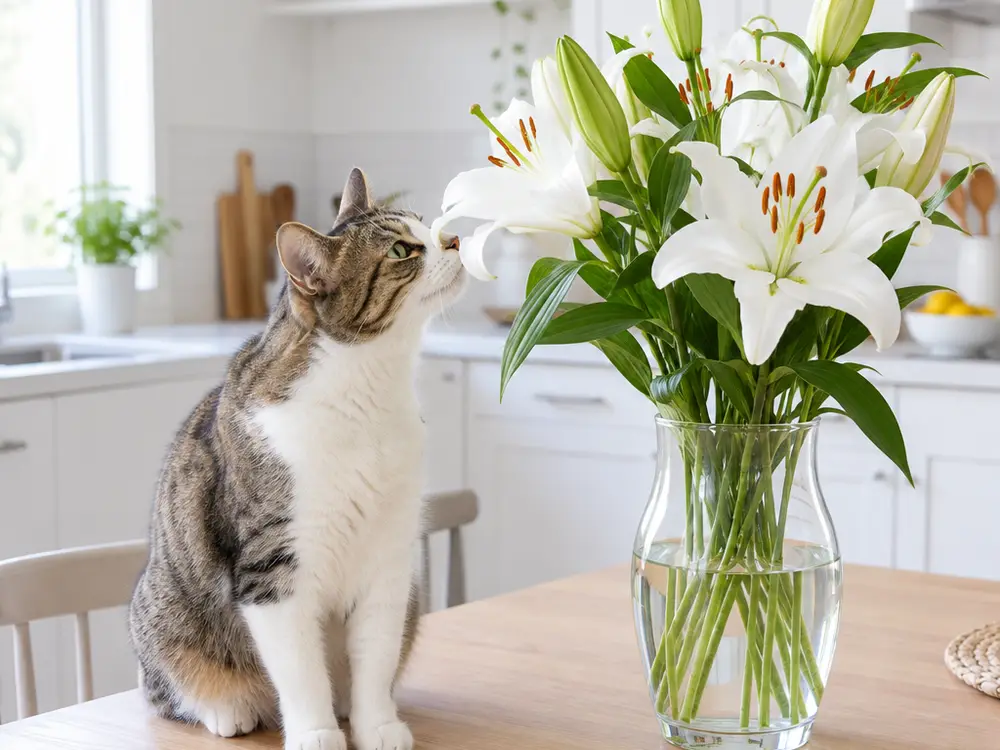
For cut flowers, roses, sunflowers, gerbera daisies, snapdragons, zinnias and freesias are listed as non-toxic. Be careful with mixed bouquets: florists often add lilies, baby's breath, eucalyptus, tulips or chrysanthemums, which are not safe. Ask for a lily-free bouquet, or remove any lilies before the flowers come inside.
Cat-safe herbs and plants cats can chew
Giving your cat something safe to chew is one of the best ways to protect your other plants:
- Cat grass (oat, wheat or barley grass) is cheap, grows in a week and gives your cat a legal "salad". Many cats nibble it and leave the houseplants alone.
- Catnip is safe. About two-thirds of cats react to it with a few minutes of happy, silly behaviour. See catnip explained.
- Basil is non-toxic and fine on a shared kitchen windowsill.
Avoid mint, lavender, oregano and chives in a cat home. Mint and lavender are on the ASPCA's toxic list, and chives belong to the onion family, which damages cats' red blood cells.
Popular plants that are NOT safe for cats
These are some of the best-selling houseplants, and all of them are listed as toxic to cats:
| Plant | Why it's a problem | Typical signs |
|---|---|---|
| True lilies and daylilies | Acute kidney failure, even from pollen | Vomiting, lethargy, then little or no urine. Emergency |
| Sago palm | Severe liver damage | Vomiting, bloody diarrhea, collapse. Emergency |
| Pothos, philodendron, monstera, dieffenbachia | Calcium oxalate crystals | Drooling, pawing at the mouth, vomiting |
| Peace lily, ZZ plant, arrowhead vine | Calcium oxalate crystals | Mouth irritation, drooling |
| Snake plant | Saponins | Vomiting, diarrhea |
| Aloe vera | Saponins and anthraquinones | Vomiting, diarrhea, lethargy |
| Jade plant | Unknown toxin | Vomiting, wobbliness, depression |
| Kalanchoe | Cardiac glycosides | Vomiting; rarely heart rhythm problems |
| Fiddle-leaf fig, rubber plant (Ficus) | Irritant sap | Mouth and skin irritation, vomiting |
| Dracaena (corn plant, dragon tree) | Saponins | Vomiting, drooling, dilated pupils |
| English ivy | Saponins | Vomiting, diarrhea, drooling |
| Tulips, daffodils, hyacinths | Bulbs are the most toxic part | Vomiting, diarrhea, drooling |
| Cyclamen, azalea, oleander | Glycosides and grayanotoxins | Vomiting; heart problems with azalea and oleander |
Our toxic foods and plants list has more detail on symptoms and what to do.
Swap this for that: cat-safe alternatives to popular plants
| Instead of… | Try… |
|---|---|
| Monstera or fiddle-leaf fig (big statement plant) | Parlor palm, areca palm or money tree |
| Pothos or philodendron (trailing) | Hoya, burro's tail or spider plant |
| Snake plant or ZZ plant (low-care, low light) | Cast iron plant or ponytail palm |
| Aloe vera or jade plant (succulent) | Haworthia or echeveria |
| Peace lily (flowers in shade) | Moth orchid, African violet or bromeliad |
| Lilies in a bouquet | Roses, sunflowers, gerberas or snapdragons |
| Mint or lavender on the windowsill | Basil, cat grass or catnip |
How to check any plant before you buy it
- Find the botanical name. Common names are confusing: "peace lily" and "calla lily" are not true lilies but are still toxic, while "Peruvian lily" and "spider plant" are different plants entirely. The Latin name on the label is what counts.
- Look it up in the ASPCA's "Toxic and Non-Toxic Plants" database, or ask your vet.
- Don't trust a "pet-friendly" tag alone. Store labels are sometimes generic or wrong.
- Rinse new plants and wipe the leaves to remove pesticide residue, and skip systemic insecticides and leaf-shine sprays.
- Check the whole plant, including the topping. Cocoa-shell mulch and slow-release fertilizer pellets can be harmful if eaten.
How to stop your cat eating your plants (even safe ones)
- Offer cat grass in a spot your cat already likes. Chewing is a normal behaviour, so give it a legal outlet.
- Use height wisely. Wall shelves, plant stands and hanging baskets help, but a determined cat can climb, so height is not a substitute for choosing safe plants. Our guide to vertical space for cats helps you plan shelves that are for the cat, not the ficus.
- Protect the soil. Large pebbles, a mesh cover or pine cones on top stop digging and using the pot as a litter box.
- Make leaves less fun. Double-sided tape on the stand, or moving the plant away from your cat's favourite window perch, often solves it.
- Beat boredom. Plant chewing is often a sign of a bored indoor cat. Two or three short play sessions a day usually reduce it.
- Never use essential-oil or citrus-oil sprays as a deterrent. Concentrated oils can be toxic to cats.
What to do if your cat eats a plant
- Identify the plant. Take a photo or bring a piece of it with you.
- Check your cat's mouth for leaf pieces, and watch for drooling, pawing at the mouth, vomiting or lethargy.
- Call your vet or an animal poison helpline if the plant is toxic, unknown or if your cat seems unwell. In the US: ASPCA Animal Poison Control (888) 426-4435 or Pet Poison Helpline (855) 764-7661 (fees may apply).
- Any contact with lilies or sago palm is an emergency. Go to a vet immediately, even if your cat looks fine.
- Don't make your cat vomit unless a vet tells you to.
See also our emergency symptoms guide and cat first aid kit.
Frequently asked questions
Are spider plants safe for cats?
Yes. Spider plants (Chlorophytum comosum) are non-toxic to cats. Many cats love chewing them, and eating a lot can cause mild vomiting, so hang the plant high or offer cat grass instead.
Are snake plants safe for cats?
No. Snake plants (Sansevieria / Dracaena trifasciata) contain saponins that can cause vomiting and diarrhea. Poisoning is usually mild, but choose a cast iron plant or ponytail palm instead.
Is monstera toxic to cats?
Yes. Monstera, like pothos and philodendron, contains calcium oxalate crystals that irritate the mouth and cause drooling and vomiting. A parlor palm or areca palm gives a similar tropical look safely.
Are succulents safe for cats?
Some are. Haworthia, echeveria, burro's tail and Christmas cactus are non-toxic. Aloe vera, jade plant, kalanchoe and euphorbias are toxic.
Is a peace lily as dangerous as a true lily?
No. A peace lily is not a true lily. It causes mouth irritation and drooling rather than kidney failure. True lilies (Lilium) and daylilies (Hemerocallis) are the deadly ones, and any contact needs an emergency vet visit.
Are orchids safe for cats?
Yes. Moth orchids (Phalaenopsis) are non-toxic to cats and one of the best flowering plants for a cat home.
Do cats need cat grass?
It isn't essential, but many cats enjoy chewing grass, and a pot of cat grass is a safe outlet that often protects your other plants.