Catnip Explained: How It Works, Is It Safe, and Alternatives
Why catnip makes cats roll, rub and zoom, why some cats don't react, how to use it safely, and alternatives like silvervine, valerian and Tatarian honeysuckle.
On this page
Few things are as entertaining as a cat meeting catnip for the first time: sniffing, licking, rolling, drooling, then dashing around the room like a kitten. But what's actually happening? And is it safe?
What is catnip?
Catnip (Nepeta cataria) is a herb in the mint family, native to Europe and Asia and now common worldwide. Its leaves and stems contain an aromatic oil called nepetalactone, the compound responsible for cats' reactions.
Catnip is sold dried, as a spray, inside toys, or as a live plant you can grow on a windowsill.
How does catnip work?
When a cat smells nepetalactone, it binds to scent receptors in the nose and triggers a response in parts of the brain linked to emotion and pleasure. Research suggests it stimulates the brain's natural "feel-good" opioid system, which helps explain the blissful behavior.
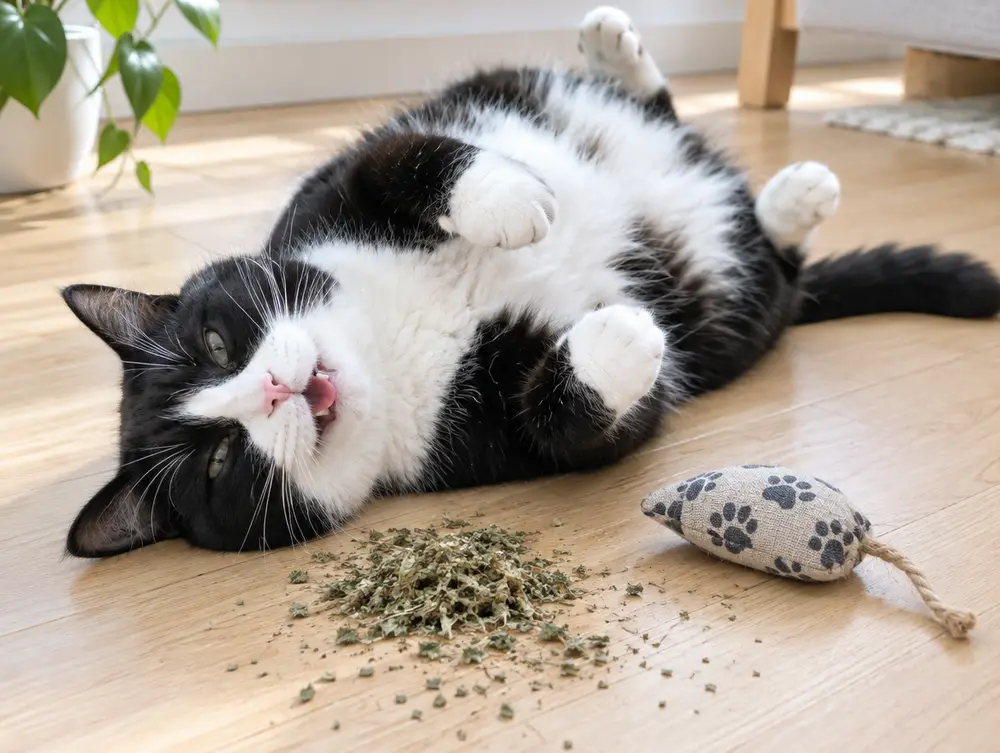
Typical reactions
- Sniffing, licking and chewing the catnip
- Rubbing the head and cheeks against it
- Rolling over and over
- Drooling, purring or meowing
- Bursts of playful energy, chasing and kicking
- Some cats become calm and mellow instead
The reaction usually lasts around 10–15 minutes. Afterwards, most cats become temporarily "immune" and won't react again for a while, often half an hour or more.
Sniffing tends to excite, eating tends to relax. Many cats become more active when smelling catnip and more sedate after eating some.
An unexpected bonus: mosquito repellent
Japanese researchers found in 2021 that when cats rub and roll on catnip and silvervine, they coat their fur with compounds that repel mosquitoes. The famous rolling behavior may have evolved partly as natural insect protection.
Why doesn't my cat react to catnip?
Sensitivity to catnip is inherited. Roughly half to two-thirds of cats respond; the rest simply don't care. There's nothing wrong with a cat who ignores it.
- Kittens usually don't respond until they're around 3–6 months old.
- Older cats may become less responsive.
- Catnip loses potency over time. Old, stale catnip may not work even on a responsive cat.
Is catnip safe?
Yes. Catnip is considered safe and non-addictive for cats. A few sensible precautions:
- Use small amounts: a pinch of dried catnip or a toy is plenty. Eating large quantities can cause mild vomiting or diarrhea.
- Watch for over-excitement: a few cats become overstimulated and may swat or bite. Give them space, and supervise catnip sessions with multiple cats in case play turns into squabbles.
- Don't overuse it: once or twice a week keeps it special. Cats can become less responsive with constant exposure.
- Store it in an airtight container, in the freezer if you buy in bulk, to keep it fresh, and out of your cat's reach (determined cats will break into the bag).
Smart ways to use catnip
- Encourage scratching post use: rub catnip on a new post. See scratching furniture.
- Make the carrier less scary: a little catnip on the carrier blanket before a vet trip (for cats who relax with it).
- Encourage exercise: sprinkle on toys or a cardboard scratcher to motivate lazy or overweight cats.
- Enrich a new environment: a catnip toy can help some cats engage with a new home.
- Refresh old toys: store toys in a container with dried catnip.
Catnip alternatives
If your cat doesn't respond to catnip, they may respond to something else. A study testing cats' responses found that most cats responded to at least one of these plants:
| Plant | Notes |
|---|---|
| Silvervine (Actinidia polygama, "matatabi") | Popular in Japan. In research, a large majority of cats responded, including many that ignored catnip. Sold as powder or sticks. |
| Tatarian honeysuckle wood | Sold as wood chips or sticks. Around half of cats responded. Only use products sold for cats: the berries are not safe. |
| Valerian root | Strong earthy smell (unpleasant to most humans). Many cats respond with excitement. |
| Cat thyme (Teucrium marum) | Less commonly available; some cats love it. |
Introduce any new plant in small amounts and observe your cat's reaction.
Grow your own
Catnip is easy to grow in a sunny pot. Be warned: cats may destroy the plant before it's established, so protect young plants with a wire cover. Cat grass (usually wheat, oat or barley grass) is a different plant. Many cats enjoy chewing it, and it's a safe alternative to houseplants, many of which are toxic. See toxic foods and plants.