Catifying Your Home: Shelves, Cat Trees and "Cat Highways"
How to create a cat-friendly home with vertical space, cat trees, wall shelves, window perches and hiding places — even in small apartments.
On this page
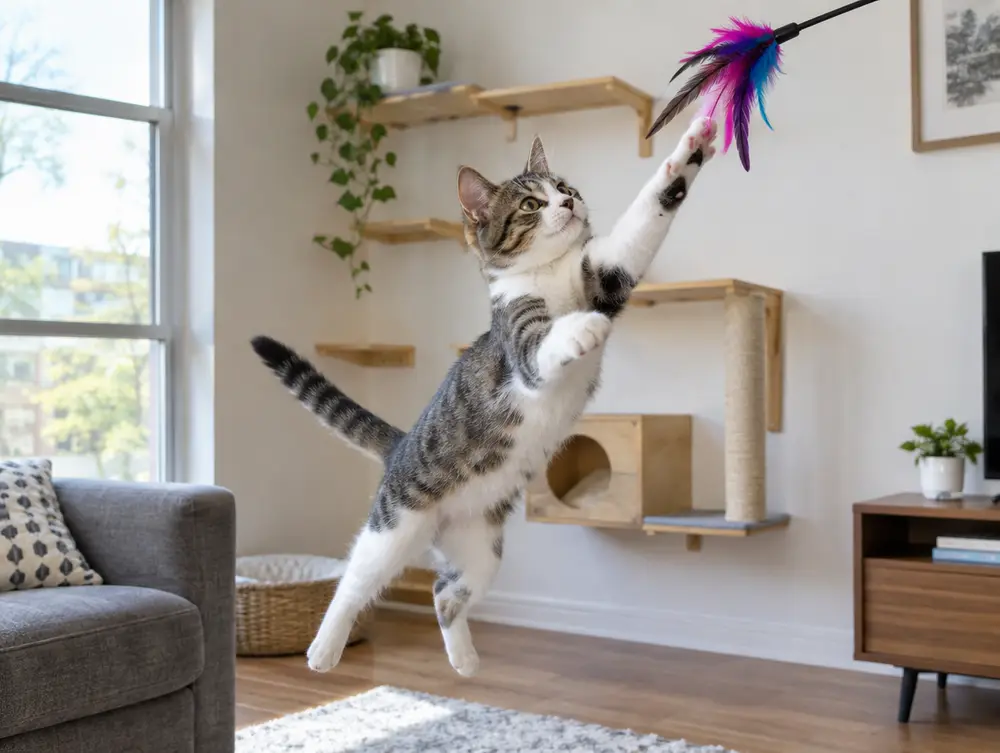
To a cat, the world isn't just floor space — it's three-dimensional. Climbing, perching and watching from above are central to how cats feel safe. "Catification" means designing your home with that in mind. It's especially valuable for indoor cats, small apartments and multi-cat homes.
Why vertical space matters
- Security: high places let cats monitor their territory and escape perceived threats.
- Exercise: climbing and jumping build muscle and burn energy.
- Reduced conflict: in multi-cat homes, more territory at different heights means less competition. Cats often establish a "timeshare" of favorite spots.
- More space: vertical territory effectively enlarges a small apartment.
Cat trees
Look for:
- Stability — a heavy base or a model that can be fixed to the wall. Wobbling trees get ignored, and can tip over.
- Height — tall enough to reach a window or a high vantage point.
- Sturdy platforms big enough for your cat to lie stretched out (large breeds need extra-wide ones).
- Sisal posts for scratching.
- A hiding spot or cubby for cats who like enclosed spaces.
Place a cat tree next to a window — it will be used far more.
Wall shelves and "cat highways"
A cat highway is a route of shelves, steps and walkways around a room at different heights, allowing your cat to travel without touching the floor.
- Secure shelves into studs or with strong wall anchors — they must hold a jumping cat.
- Space them for easy jumps (usually around 30–45 cm / 12–18 in apart, less for seniors and kittens).
- Add non-slip surfaces (carpet or cork).
- Avoid dead ends — give each route at least two ways off, so one cat can't trap another.
- Include destinations: a window perch, a bed, a scratching surface.
Window perches
Watching birds, people and passing cars is great mental stimulation. Suction-cup or clamp-on window perches work well. A bird feeder outside can add entertainment — though some cats get frustrated by birds they can't reach, so watch for signs of stress.
Hiding places
Cats also need safe, enclosed spots to retreat to:
- Covered beds or "cat caves"
- Cardboard boxes on their side
- A cubby in a cat tree
- Space under a bed or behind a sofa, left accessible
- For shy cats, put hiding spots in every main room.
Resources in a multi-cat home
Spread out and multiply key resources: food, water, litter boxes, scratching posts, resting places and toys. Different cats may prefer different heights — one may claim the top of the fridge, another the sofa arm.
Catification on a budget
- Clear a bookshelf level and add a cushion.
- Sturdy furniture arrangements can create routes: sofa → sideboard → shelf.
- Cardboard boxes make excellent free hideouts and scratchers.
- Second-hand cat trees are widely available — check stability and clean thoroughly.
For seniors and cats with mobility issues
Add ramps and steps to favorite high spots, lower perches, and extra-wide platforms. See senior cat care.
Outdoor space safely
A catio (enclosed patio or window box) or a fully netted balcony gives indoor cats safe fresh air. See harness training and balcony safety.