Why Cats Need Play — and How Much Is Enough
Why daily play matters for your cat's physical and mental health, how long to play at each age, and how to play in a way that satisfies the hunting instinct.
On this page
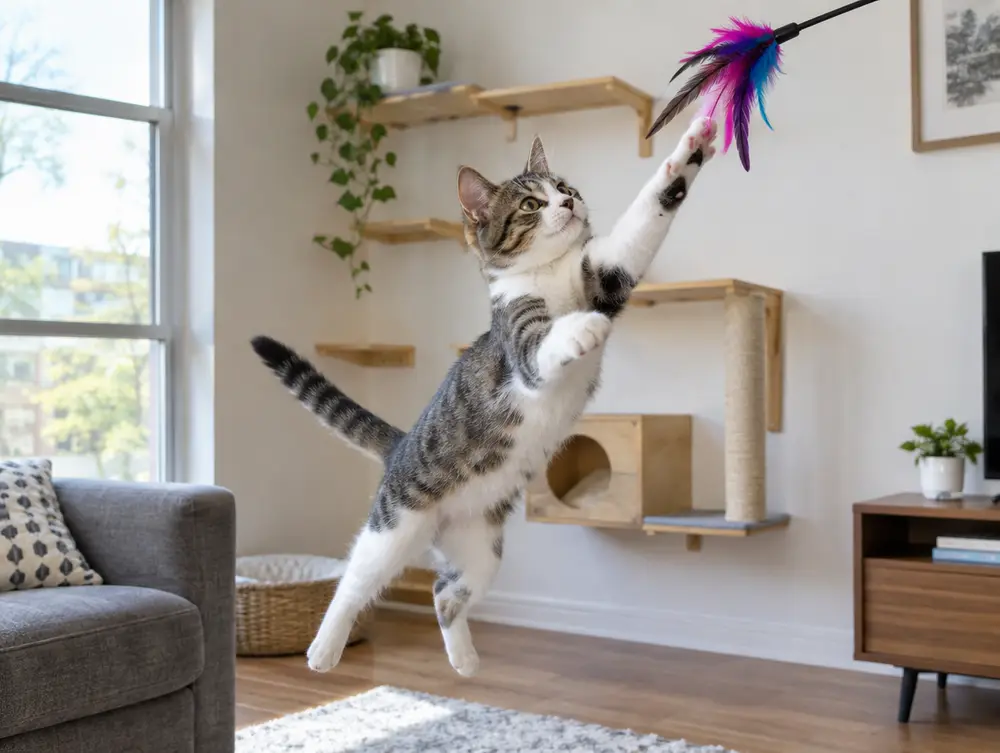
Play isn't a luxury for cats — it's how they express their hunting instinct. Indoor cats in particular have few natural outlets for stalking, chasing and pouncing. Without them, boredom and pent-up energy often show up as behavior problems: biting, night-time zoomies, over-grooming, scratching, or weight gain.
Benefits of daily play
- Physical exercise — helps prevent obesity and keeps joints and muscles healthy
- Mental stimulation — reduces boredom and stress
- Fewer behavior problems — less biting, ambushing and night-time activity
- Confidence — shy cats become bolder through successful "hunts"
- Bonding — interactive play builds your relationship
How much play?
| Age | Suggested daily play |
|---|---|
| Kittens | Several short sessions (5–10 min) through the day |
| Young adults (1–6 years) | At least 2 sessions of 10–15 minutes |
| Mature adults | 2 sessions of 10 minutes |
| Seniors | Short, gentle sessions — still important |
High-energy breeds like Bengals, Abyssinians and Siamese may need more. Watch your cat: you've played enough when they're breathing a little faster, lie down or lose interest. Stop before overexertion — open-mouth panting means it's time for a break.
How to play like prey
Cats are ambush hunters. The best play mimics a mouse, bird or insect:
- Move the toy away from your cat, not toward them. Prey never runs at a predator.
- Use cover: drag the toy behind furniture, under a blanket, around corners.
- Vary speed: slow creeping, sudden dashes, then freezing still.
- Let your cat catch it — often. Constant failure is frustrating.
- Give short bursts of chase with pauses; cats are sprinters, not marathon runners.
- Wind down by slowing the toy, like tired prey.
- Finish with a "kill" and a meal or treat. This completes the hunt-catch-eat-groom-sleep sequence and helps your cat settle.
Solo play and enrichment
Interactive play with you matters most, but between sessions:
- Puzzle feeders and treat balls — let your cat "hunt" part of their daily food
- Rotating toys — put most toys away and swap a few in every few days so they stay novel
- Cardboard boxes and paper bags (handles removed)
- Window perches and bird feeders outside — "cat TV"
- Cat trees and shelves — see catification
- Scent enrichment — catnip, silvervine or valerian toys (not all cats respond)
Safety
- Put wand toys and anything with string away after play — swallowed string can cause serious intestinal injury.
- Avoid toys with small parts that can be chewed off and swallowed.
- Replace damaged toys.
- Supervise play with ribbons, feathers and elastic.
Signs your cat needs more play
- Ambushing ankles and biting hands
- Night-time zoomies and early-morning wake-ups
- Knocking things over
- Over-grooming
- Weight gain
- Excessive meowing for attention