20 Surprising Cat Facts Every New Owner Should Know
Fascinating, true cat facts for beginners: why orange cats are usually male, cats can't taste sweet, kittens' blue eyes, nose prints, the oldest cat ever and more.
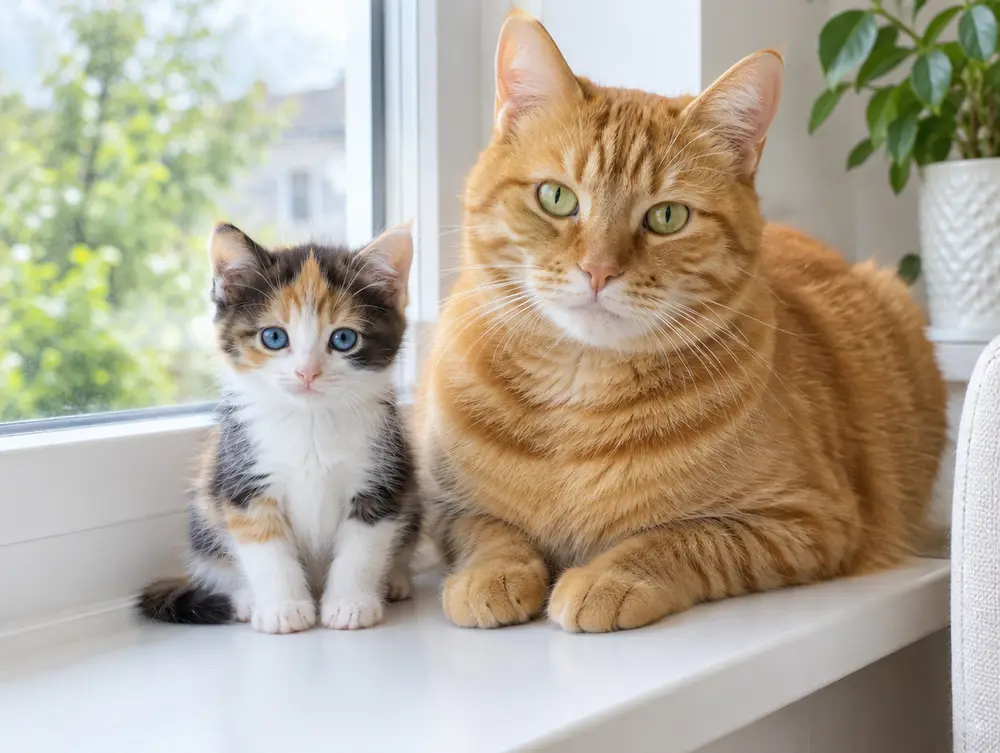
Cats share our homes, but they're full of surprises. Here are 20 fascinating, accurate facts about cats. Some are just fun, and many help you understand your own cat a little better.
Body and biology
1. Most orange cats are male, and calico cats are almost always female
The genes for orange and black fur sit on the X chromosome. Females (XX) can carry both and become calico or tortoiseshell; males (XY) usually can't. Rare male calicos almost always have an extra X chromosome (XXY) and are usually infertile. Orange cats are more often male because males only need one copy of the orange gene.
2. Cats can't taste sweetness
The gene for the sweet taste receptor doesn't work in cats. As strict carnivores, they never needed it. See how cats see, hear and smell.
3. All kittens are born with blue eyes
Pigment in the iris develops gradually, and adult eye color usually starts to show from around 6–7 weeks of age, settling over the following months.
4. Kittens are born blind and deaf
Newborn kittens' eyes and ear canals are sealed. Eyes typically open at around 7–10 days, and kittens rely on smell, touch and warmth to find their mother.
5. A cat's nose print is unique
The ridged pattern on a cat's nose leather is thought to be unique to each cat, much like a human fingerprint.
6. Cats sweat only through their paw pads
That's why a nervous cat at the vet may leave damp paw prints on the table. Cats cool down mainly by grooming (saliva evaporating from the fur) and resting in cool places. Panting in cats is not normal outside of brief intense play. It can signal heatstroke, stress or a breathing problem. See emergency symptoms.
7. Cats have a third eyelid
The nictitating membrane is a thin, pale membrane in the inner corner of each eye that protects and moistens the eye. You don't usually see it. If it's visible across your cat's eyes, it can be a sign of illness, so mention it to your vet.
8. Their collarbone floats
Cats' collarbones aren't attached to other bones the way ours are. Together with a flexible spine, this lets cats squeeze through surprisingly small gaps. Generally, if the head fits, the body follows, which is why window screens and balcony nets matter. See cat-proofing your home.
9. Cats' hearts beat about twice as fast as ours
A healthy cat's resting heart rate is typically around 140–220 beats per minute, compared with about 60–100 in adult humans.
10. Cats can jump several times their own height
Powerful hind legs and a flexible spine let a healthy cat leap onto counters and wardrobes in a single bound. Senior cats with arthritis lose this ability gradually, which is often one of the first signs of joint pain. See signs of pain.
Senses and behavior
11. Cats' ears rotate about 180 degrees
Each ear is moved by around 30 muscles and can swivel independently to pinpoint sounds.
12. Adult cats meow mostly to humans
Kittens meow to their mothers, but adult cats rarely meow to each other. They communicate mainly with scent, body language and other sounds. Cats seem to keep meowing as adults largely because it works on us.
13. Cats spend a large part of their day grooming
Grooming can take up a big chunk of a cat's waking hours. It keeps the coat clean, regulates temperature, spreads scent and helps them relax. Sudden over- or under-grooming can signal stress, pain or illness.
14. Cats sleep about two-thirds of their lives
Adult cats typically sleep 12–16 hours a day. See why cats sleep so much.
15. Many cats have a preferred paw
Studies have found many cats show a paw preference, much like human handedness, and suggest that female cats tend to favor their right paw and males their left.
16. Cats purr at around 25–150 vibrations per second
And they purr on both the in-breath and the out-breath. But purring doesn't always mean happiness. See why do cats purr?
History and records
17. Cats domesticated themselves (mostly)
Domestic cats descend from the African wildcat (Felis lybica). Around 10,000 years ago, when people in the Near East began farming and storing grain, wildcats were attracted by the rodents and gradually lived alongside humans. A cat buried with a person in Cyprus about 9,500 years ago is among the earliest evidence of a close bond.
18. Ancient Egyptians revered cats
Cats were associated with the goddess Bastet, and many were mummified. Harming a cat could bring severe punishment.
19. The oldest cat on record lived to 38
According to Guinness World Records, Creme Puff, a cat from Texas, lived to 38 years and 3 days (1967–2005). Most indoor cats today live around 12–18 years, and many reach 20. See senior cat care.
20. A group of cats has its own names
A group of cats is a clowder (or a glaring), and a group of kittens is a kindle or a litter. A male cat is a tom, an unspayed female is a queen, and a neutered male is sometimes called a gib.
Want more?
Find out how old your cat is in human years with our cat age calculator, discover which breed suits you with the breed selector quiz, or start with the basics in are you ready for a cat?