Brushing Your Cat: Shedding, Mats and Hairballs
How often to brush short-haired and long-haired cats, the right tools, how to deal with mats, seasonal shedding and how to reduce hairballs.
On this page
Cats spend a large part of their waking hours grooming, but regular brushing still helps: it removes loose hair before it ends up on your sofa or in your cat's stomach, prevents painful mats in long coats, and gives you a chance to check for lumps, fleas and skin problems.
How often to brush
| Coat type | Frequency | Examples |
|---|---|---|
| Short, fine | Once a week | Siamese, Oriental, Bengal |
| Short, dense or plush | 1–2 times a week | British Shorthair, Chartreux |
| Semi-long | 2–3 times a week | Ragdoll, Birman, Siberian |
| Long, thick | Daily | Persian, Himalayan |
| Curly | Gently, weekly, with a soft mitt | Devon Rex, Cornish Rex |
| Hairless | No brushing — regular bathing instead | Sphynx |
Brush more often during seasonal shedding, usually in spring and autumn, when many cats lose their undercoat. Indoor cats under artificial light often shed year-round.
The right tools
- Rubber grooming mitt or brush — great for short coats and for cats who dislike brushes.
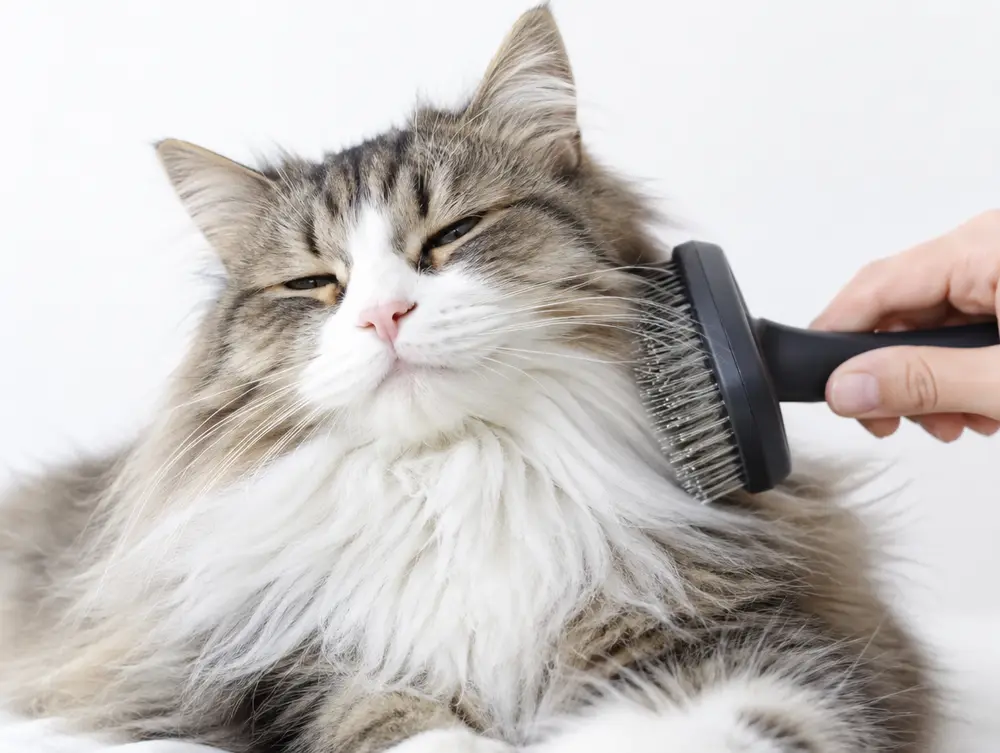
- Slicker brush (fine wire bristles) — removes loose undercoat; use gently.
- Wide- and fine-toothed metal comb — essential for long-haired cats; reaches down to the skin and finds tangles.
- Undercoat de-shedding tool — very effective but use sparingly and lightly, as overuse can damage the coat and irritate skin.
- Soft bristle brush — for finishing and for sensitive cats.
How to brush a cat who isn't keen
- Start young and short. A few strokes, a treat, then stop — before your cat gets annoyed.
- Start where cats like to be touched: cheeks, head, back of the neck.
- Brush in the direction of hair growth.
- Watch body language. Tail twitching, skin rippling or ears turning back mean "enough". See cat body language.
- Build up gradually to the belly, back legs and tail over days and weeks.
- Pair with good things: a lickable treat or meal time.
Mats and tangles
Mats form where fur rubs — behind the ears, armpits, belly, back legs and under the tail. They pull painfully on the skin and can hide sores.
- Work small tangles apart gently with your fingers and a comb, holding the hair at the base to avoid pulling the skin.
- A little cornstarch can help loosen a mat.
- Never cut out mats with scissors — cat skin is thin and easily cut, and mats lie close to it. Use electric clippers or ask a groomer or vet.
- Severely matted cats may need to be clipped by a professional, sometimes under sedation.
- Older, arthritic or overweight cats often can't reach their back and rear — they need extra help.
Hairballs
When cats groom, they swallow loose hair. Most passes through the gut, but some forms a hairball that is vomited up — a sausage-shaped mass, often after retching.
To reduce hairballs:
- Brush regularly, especially long-haired cats and during shedding season.
- Consider a hairball-control food with added fiber, or a hairball remedy recommended by your vet.
- Encourage hydration — see cats and water.
Excessive shedding or bald patches
Normal shedding leaves the coat thick and even. See your vet if you notice bald patches, redness, scabs, flakes, greasy fur or constant scratching — possible signs of fleas, allergies, ringworm, stress-related over-grooming or other medical problems.