Best Types of Cat Toys: Wands, Puzzle Feeders and More
The types of cat toys that actually work — wand toys, kicker toys, balls, puzzle feeders, catnip toys — plus DIY ideas and toy safety.
On this page
You don't need to spend a fortune on toys. Most cats have a few favorite types, and the way you use a toy matters more than what it costs. Here's a guide to what works — and what to avoid.
Interactive toys (you + cat)
Wand or fishing rod toys
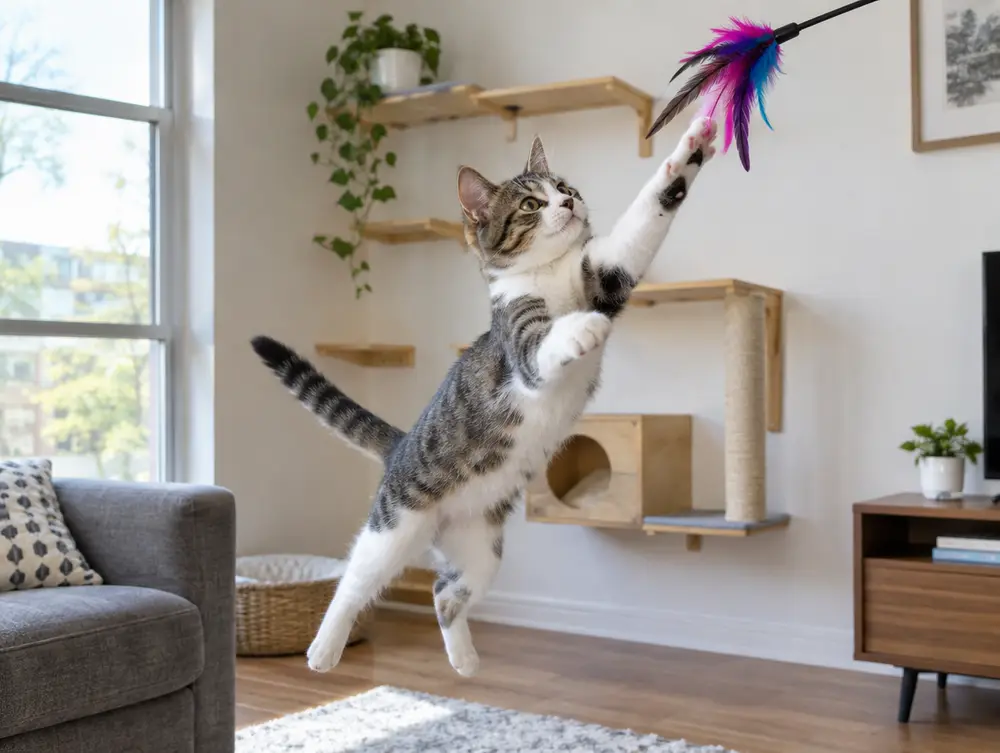
The single most useful toy for most cats. A stick with a string and a lure (feathers, fabric, a toy mouse) lets you mimic prey while keeping your hands away from teeth and claws.
- Choose different lures to find your cat's preference: bird-like (feathers, fluttering), mouse-like (fur, running along the floor) or insect-like (small, darting).
- Store safely after play — strings are a swallowing hazard.
Laser pointers
Exciting for many cats but frustrating because they can never catch the prey. If you use one, finish on a real toy or treat. Never shine it in eyes.
Solo toys
- Small balls and toy mice — lightweight, easy to bat and chase. Cats love finding them under furniture.
- Kicker toys — long, plush toys a cat can hug and bunny-kick. Great for play biting (redirect the bite to the toy).
- Crinkle toys and balls — the sound attracts attention.
- Track toys — balls in a circular track. Good for kittens and short bursts of solo play.
- Electronic moving toys — can entertain some cats; many lose interest. Supervise at first.
- Tunnels — lots of cats love to hide and pounce from them.
Food puzzles and foraging toys
Puzzle feeders let cats "work" for their food, as they would in the wild. Studies suggest they can help with weight management, boredom and some behavior problems.
- Treat balls — dry food falls out as your cat rolls them
- Puzzle boards — food hidden in wells, under sliders or behind flaps
- Snuffle mats — kibble hidden in fabric strips
- DIY: a toilet-roll tube with folded ends and a few kibbles inside, or an egg carton with treats
Start easy so your cat succeeds quickly, then gradually increase difficulty. Use part of the daily ration, not extra food.
Scent toys
- Catnip — about half to two thirds of cats respond, with rolling, rubbing and playfulness for around 10 minutes. Kittens under a few months usually don't respond.
- Silvervine (matatabi) and valerian — some cats who ignore catnip respond to these.
- These are safe in normal amounts. Refresh or rotate to keep them interesting.
DIY toys
- Cardboard boxes — simple, free, endlessly popular
- Paper bags (remove handles)
- Crumpled paper balls
- Bottle caps (large enough not to swallow; supervise)
- A sock filled with catnip, tied tightly
Toys to avoid or supervise
- Loose string, yarn, thread, ribbon, tinsel, hair ties and rubber bands — dangerous if swallowed
- Toys with small glued-on parts (eyes, bells) that can come off
- Very small balls that could be swallowed
- Plastic bags — suffocation risk
Keep toys interesting
- Rotate: keep most toys in a closed box and bring out a few at a time.
- Refresh scent: store some toys in a container with catnip.
- Act like prey — even an old toy is exciting when it "comes alive".
See why cats need play for how to play.